

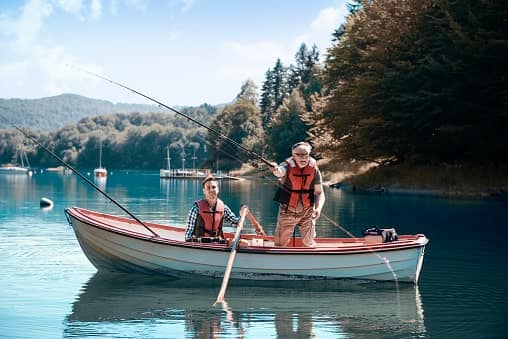
If you own a boat or other watercraft, your thoughts probably turn to the water
this time of year. As temperatures rise, you dream of skimming across the waves
or spending long afternoons drifting on a tranquil lake. Insurance is probably
the furthest thing from your mind. But if you own a boat, you have a special
need for insurance. Boat ownership exposes you to many of the same risks as
automobile and home ownership, including the risk of causing bodily injury to
other people, damage to others' property, or damage to your own property.
State law may require you to carry a minimum amount of insurance on your boat.
And if you have an outstanding boat loan, your lender probably requires you
to carry full insurance on the boat. Additionally, many marinas and yacht clubs
won't allow you to dock your boat unless you're insured. Whether required or
not, it's a good idea to have insurance on your vessel.
Homeowners insurance and boats
Homeowners insurance usually includes limited coverage for small watercraft.
A typical homeowners policy provides $1,000 worth of coverage for physical damage
that occurs while your boat is stored at your home. Homeowners insurance may
also provide some personal liability coverage to protect against claims resulting
from negligent operation of your boat, but the amount of this coverage is not
substantial. Jet skis and other similar watercraft are often excluded from homeowners
insurance coverage.
A boat by any other name...
Additional coverage can be obtained by purchasing a boat policy, a yacht policy,
or a personal watercraft policy. But in order to know what type of insurance
you need, you have to know what type of vessel you own. In the insurance world,
watercraft are typically divided into three categories:
- Boats. Generally includes watercraft between 16' and 25' 11" in length
- Yachts. Generally includes only watercraft which are 26' or longer
- Personal watercraft. Includes only jet skis, waverunners, and other similar
craft
Note that this discussion deals with recreational watercraft only; separate
policies are available for water taxis and other commercial watercraft.
Boat policies
A boat policy is a package contract, similar in many ways to automobile insurance.
While there may be some variation in boat policies, the main types of coverage
are physical damage and liability coverage. Many boat policies also include
legal defense protection, medical payments coverage, and uninsured boater coverage.
Physical damage coverage
What it covers
A boat policy typically pays to repair or replace your boat if it is damaged
or destroyed by fire, lightning, hail, windstorm, hurricane, tornado, explosion,
collision, capsizing, sinking, vandalism, or theft. (Covered perils may vary--make
sure your policy is as comprehensive as possible.) In addition to the boat itself,
outboard motors, trailers, and personal property kept aboard the boat are covered
by most boat policies. The insurer typically will also pay to protect the vessel
from further damage in the event of a mishap, or to recover the boat if it sinks
or becomes stranded.
What it doesn't cover
Physical damage that results from any of the following is typically excluded
from coverage:
- Wear and tear, latent defect, mechanical breakdown, faulty manufacturing,
war, and nuclear hazard
- Repair or restoration
- Carrying people or property for a fee
- Using property in a official race
- Using fishing gear and portable electronic, photographic, and water sports
equipment
How claims are paid
In the event of damage or theft, the amount of your claim payment will be determined
using one of the following methods:
- Replacement cost. Payment is sufficient to replace the property
- Agreed value. Payment is limited to a specific amount stated in the policy
- Actual cash value. Payment is limited to the depreciated value of the property
Your policy should state which of the above methods will be used to settle
your claim. Some insurance companies automatically use an agreed value for boats
under 15 years of age, and switch to the actual cash value standard for boats
older than that. Certain items (such as sails and outboard motors) are almost
always covered on an actual cash value basis. Given a choice, replacement cost
coverage is generally most advantageous to you, and may be required by your
lender (if applicable).
Liability coverage
As with auto and homeowners insurance, this is the most critical component
of any watercraft insurance. The reason: liability claims against you for bodily
injury and property damage can easily reach $100,000 or more, depending on the
severity of the accident. If you have inadequate liability coverage (or worse
yet, none at all), a sizable claim against you can put your home, savings, and
other assets in jeopardy.
What it covers
Liability coverage provides protection for legal claims if you are found liable
for a boating accident. It typically covers the legal and financial consequences
of accidental bodily injury or death, as well as damage to other boats, docks,
and personal property. Coverage is usually extended to you, your family members,
and others who operate your boat with your permission. In today's litigious
society, huge personal liability judgments are not unusual. Consequently, your
coverage in this area should be as high as needed to shield your assets and
future earnings. Liability coverage is typically available in amounts ranging
from $100,000 to $1,000,000. For additional protection, consider purchasing
a personal umbrella liability policy.
What it doesn't cover
Liability coverage under a boat policy generally contains a number of exclusions.
The following is a list of common exclusions; however, your policy may differ:
- Bodily injury or property damage that is expected or intended by the insured
- Liability of any person using the insured watercraft without permission
- Damage to property owned by or in the care, custody, and control of the
insured
- Injury to persons eligible for workers' compensation benefits
- Liability of a person engaged in the business of selling, repairing, storing,
or moving watercraft
Legal defense protection
Legal defense coverage is typically optional under a boat policy. It usually
covers legal defense costs for lawsuits brought against you for damage caused
by an unauthorized person operating your boat. Court costs, attorney's fees,
and investigation expenses are normally covered.
Medical payments coverage
Boat policies may also include medical payments coverage, which pays for medical
expenses resulting from at-fault boating accidents when someone is injured "in,
upon, getting into or out of the insured watercraft." The broadest policies
may also include medical payments coverage for waterskiing injuries. Medical
payments coverage may or may not be necessary, depending on the scope of your
health insurance coverage.
Uninsured boaters coverage
Uninsured boaters coverage is available under a boat policy as an option. It
provides payment up to a specified limit--generally $10,000 per accident--when
you or a member of your family suffers bodily injury caused by an uninsured
boater. If the uninsured boater also has insufficient assets to compensate you
for your losses, the financial consequences could be disastrous. With this possibility
in mind, it's probably wise to purchase this coverage with a relatively high
limit.
Limitations
Boat policies may limit usage of the insured vessel to a specified territory.
The broadest policies cover the vessel while being operated on any inland body
of water (rivers, lakes, etc.) within the continental United States and Canada,
and coastal waters of the same areas, up to a certain limit. The most restrictive
policies provide coverage only on a specified body of water and within a narrow
perimeter around that area. The coverage provided by other policies falls somewhere
between these two extremes. For example, some may limit coverage only to inland
lakes or to certain states. Many will not provide coverage for offshore waters,
such as the Gulf of Mexico.
Yacht policies
A yacht policy is very similar to a boat policy, in that it provides coverage
for physical damage to your vessel and for personal liability claims against
you. However, in a yacht insurance policy, these coverages are called "hull
insurance" and "property and indemnity coverage." Yacht owners
can also purchase several optional coverages.
Hull insurance
This coverage pays to repair or replace your vessel if it is damaged or destroyed.
Typical covered perils include fire, lightning, hail, windstorm, hurricane,
tornado, explosion, collision, capsizing, sinking, vandalism, and theft. However,
policies vary from one insurer to another. In addition to the yacht itself,
the sails, furniture, outboard motor, and machinery are also covered. Dinghies
and trailers may be covered under a separate policy endorsement.
Protection and indemnity coverage
This section provides marine liability coverage in the event that a liability
claim is filed against you for bodily injury and property damage resulting from
an at-fault accident. This coverage may be subject to certain exclusions.
Optional coverages
Like boat insurance, yacht insurance policies typically provide optional coverage
for legal defense, medical payments and uninsured boaters (see above). Yacht
owners can also buy a hurricane protection endorsement, which will pay to haul
your yacht out of the water if a hurricane is approaching and put it back in
the water after the hurricane has passed.
Limitations
Most yacht policies include several limitations, called "warranties."
A navigational warranty limits the operation of the insured vessel to a specified
area. Depending on your policy, the size of the covered region could vary dramatically.
Many yacht policies also include a lay-up warranty, which requires you to take
your yacht out of operation for certain periods during the year. For example,
a yacht policy for a vessel harbored in New England might require that vessel
to be out of commission during the winter months.
Personal watercraft insurance
If you own a personal watercraft, you might actually have a difficult time insuring
it. Many insurers refuse to insure these craft, because they pose a much greater
risk than other types of watercraft. According to some statistics, 45 percent
of all boating accidents involve personal watercraft. However, certain insurance
companies now specialize in insuring personal watercraft because of their popularity.
If you own a personal watercraft, make sure you purchase an insurance policy
that includes bodily injury, property damage, liability, and theft coverage.
How much does boat/yacht insurance cost?
The cost depends on a number of considerations, including the age, size, type,
and power of your vessel. Smaller boats are usually less expensive to insure
than larger boats, and, in general, speedboats will be more expensive to insure
than sailboats. Also, where and when you use your vessel will affect the cost
of your insurance. For example, it's more expensive to insure a boat in coastal
waters than in inland lakes and rivers, especially in areas at risk for hurricanes.
Other factors that influence price include the security of the location where
your vessel is normally kept, the liability limits and deductibles you have
selected, your level of experience as a boater/sailor, and whether you use your
boat year-round.
Safety is of utmost importance to insurance companies, so you may find that
your insurer offers a discount when you renew your boat/yacht policy after a
year with no claims. Taking an approved boating safety course can also earn
you a discount on your premiums. Discounts are also available for protective
devices such as depth-finders, burglar alarms, and ship-to-shore radio systems.
If you insure your boat with the same company that issued your auto, life, or
homeowners insurance, you may be eligible for a multi-policy discount as well.
Please note that this description/explanation is intended only
as a guideline.