


Which business insurance premiums are tax-deductible?
Business owners can deduct the cost of premiums for several common types of coverage, including coverage for business property, liability, commercial auto and workers compensation.
Here are some common commercial policies you can deduct:
- Commercial property insurance covers damage to buildings and business property, such as equipment, inventory, and tools, that results from burglary, vandalism, theft, fire, or a natural disaster and is deductible as a business expense.
- Business liability insurance covers third-party claims related to bodily injury, property damage and accidents. It's deductible as a business expense.
- Professional liability insurance, also known as errors and omissions (E&O) insurance, shields businesses from legal claims related to copyright violations, errors and oversight, malpractice, misinformation, or neglecting to provide a promised service. You can deduct these premiums on your taxes.
- Workers’ compensation insurance covers your employees’ medical bills and lost wages if they get injured or sick at work and can’t do their job, and is tax-deductible.
- Commercial vehicle insurance protects against third-party claims of bodily injury and property damage and may also include coverage for damage to your own vehicles and medical expenses. Premiums are a tax-deductible business expense.
- Business interruption insurance helps cover lost income, rental payments and employee payroll should your company need to close temporarily; the cost of this coverage can be deducted.
- Group health insurance provides for medical, dental and vision benefits for employees and the portion of premiums the business pays can be deducted as a business expense.
Other business insurance premiums, including self-employed health or group life insurance, may also be tax-deductible. Consult a qualified income tax professional for guidance.
Which business insurance premiums are not tax-deductible?
Not all types of business insurance premiums qualify as tax-deductible. The IRS doesn't allow deductions when the business benefits from a life insurance policy, for premiums allocated to tax-exempt income, or when the business is used as collateral. And, you can't deduct premiums paid in advance.
Business insurance policies that are not tax-deductible include:
- The business is directly or indirectly a beneficiary under a life insurance policy
- The premiums are allocable to tax-exempt income (such as certain disability policies)
- The arrangement constitutes self-insurance
- The premiums are paid by a non-business creditor
- The policy is used as collateral or where the business retains a beneficial interest
- The premiums are for title insurance (which must be capitalized, or counted as an asset on your balance sheet rather than as an expense)
- The premiums are paid to certain welfare benefit funds or other arrangements the IRS deems abusive
In addition, you cannot deduct premiums you have paid in advance. The IRS cites the following example in Publication 334 (2024), Tax Guide for Small Business:
“In 2024, you signed a 3-year insurance contract. Even though you paid the premiums for 2024, 2025, and 2026 when you signed the contract, you can only deduct the premium for 2024 on your 2024 tax return. You can deduct in 2025 and 2026 the premiums allocable to those years.”
In plain terms: You can only deduct expenses in the year they apply to, even if you paid upfront for multiple years.
Can you deduct car insurance for business use?
Yes, you can deduct commercial car insurance premiums. If you operate a vehicle solely for business purposes, the IRS allows you to deduct the entire cost of ownership and operation, including cost of commercial vehicle insurance and things like registration and licensing fees, repairs, tires, gas and oil.
However, if you use your vehicle for both business and personal purposes, you must calculate the use percentage for each and apply it to your business-related tax deductions.
For instance, if you drive for work 65% of the time and 35% of the time for personal use, you may only deduct 65% of the cost of your car insurance. The IRS says you must maintain adequate records or present sufficient evidence to support your write-offs. This includes bills, receipts and invoices.
Alternatively, you may use the IRS’s standard mileage rate for vehicle-related business expenses if you don’t want to itemize. But there’s a catch.
“If you use the standard mileage rate, you cannot deduct car insurance separately, as it is already included in the rate,” Roberts says.
For the 2025 tax year, the standard rate is 70 cents per mile, according to the IRS website.
Do you have to pay taxes on business insurance claim settlements?
Whether you pay taxes on business insurance claim settlements depends on what the payout compensates for. Claims for lost profits, such as a business interruption insurance settlement, are generally taxable. Property damage payouts are not taxable unless the settlement exceeds the depreciated value of the damaged items. Worker's compensation settlements and life insurance proceeds paid to a business are generally not taxable, unless specific IRS exceptions apply.
A few examples of this are:
- Business interruption insurance claims are taxable because they compensate for lost income and operating expenses that are incurred during normal operations. That income would have been taxable, and therefore the replacement of that income is also taxable.
- Workers’ compensation claims are generally not considered taxable. However, the IRS says payouts for emotional distress without physical injury may be subject to taxation.
- Property damage claims may be taxable if the payout exceeds the depreciated or actual cash value of the damaged items.
“However, life insurance proceeds paid to a business due to the death of an insured are usually not taxable, unless specific exceptions apply – such as certain employer-owned policies that do not meet notice and consent requirements or if the transfer-for-value rule applies,” Roberts says.
Rules about business insurance and tax deductions are complex. It’s best to consult with a qualified income tax professional if you have questions about whether you must pay taxes on a business insurance claim.
How do you report business insurance on your tax return?
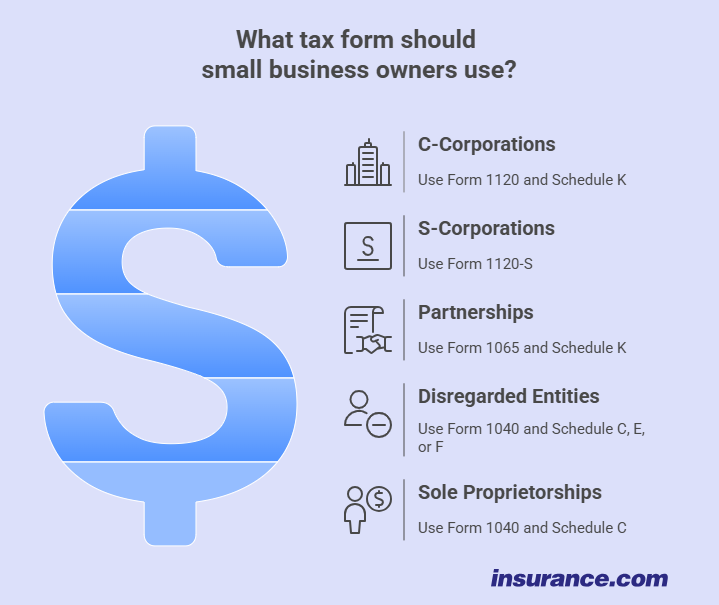
How you report business insurance expenses on your taxes depends on your business structure. Limited liability companies (LLCs) and sole proprietorships use Form 1040, Schedule C. Corporations use Form 1120, S-corporations use Form 1120S, and partnerships use Form 1065, Schedule K.
LLCs may be classified as corporations, partnerships or disregarded entities.
- Corporations should use Form 1120, with each shareholder using Schedule K to report credits, deductions and income, while S-corporations should use Form 1120S.
- Partnerships, which are LLCs with two or more members, should use Form 1065, and report credits, deductions and income on Schedule K.
- Disregarded entities, which are single-member LLCs, should use Form 1040, the same as a sole proprietorship. Income and expenses should be reported on Schedule C, E or F (depending on business type).
Sole proprietorships are single-owner businesses. These individuals should use IRS Form 1040 to report income and expenses and list deductions on Schedule C.

What our expert says
Q: Do you have to pay taxes on your insurance checks?

How much can a business save by deducting insurance premiums?
How much a business will save by deducting insurance premiums depends on the amount of business income for the year and how much was spent on insurance premiums. This will differ for every company and isn't a dollar-for-dollar credit.
Deducting business insurance premiums reduces taxable income, which means that the amount you will pay taxes on is lower. That calculation will depend on how much taxable income you had before the deductions and how much you are able to deduct in insurance expenses.
FAQ: Business insurance tax deductions
Why are business expenses tax-deductible?
Business expenses are considered tax-deductible because they are ordinary and normal expenses of running a business in your industry. The IRS states: “An ordinary expense is one that is common and accepted in your field of business. A necessary expense is one that is helpful and appropriate for your business. An expense does not have to be indispensable to be necessary.”
Can a business deduct parking expenses?
Yes, a business can deduct the cost of parking fees and tolls if they are directly related to business activities, such as a bridge toll and a parking fee to visit a client. However, you cannot deduct the cost of parking your vehicle at your workplace; the IRS considers that a nondeductible commuting expense.
Do business expenses reduce taxable income?
Yes, business expenses reduce taxable income when the IRS considers them ordinary and necessary. For business insurance, this includes commercial vehicle coverage and other insurance common to your industry. You can also deduct rent and lease payments, employee salaries and compensation, certain legal and professional fees, equipment maintenance and repair costs, and more. Consult a licensed tax professional for guidance.

In case you missed it
Stay updated with our latest insurance insights and guides
 January 13, 2026
Business liability insurance protects your business from the financial fallout of claims...
Read article April 21, 2025Sole proprietor insurance, depending on the policy, can cover claims of property...
Read article February 24, 2025Home-based business insurance, which covers business equipment, customer accidents, claims of work-related...
Read article January 6, 2025Most companies need workers comp, commercial auto and general liability insurance, but...
Read article