

Does U.S. auto insurance work in Canada?
Your U.S. car insurance policy will work in Canada thanks to a reciprocal agreement between the countries to accept each other's insurance as valid.
There's no special car insurance in Canada for visitors from the U.S., unlike Mexico, where U.S. car insurance policies aren't valid.
How does U.S. car insurance work in Canada?
U.S. car insurance works in Canada in much the same way as in the States. Canada is part of the policy territory, which is the area in which your insurance coverage applies.
“Most standard personal auto policies automatically include Canada in the ‘policy territory,’ and so there is not much the policyholder needs to change in order to have their insurance coverage apply in Canada,” says Dana Kerr, associate professor of risk management and insurance at the University of Southern Maine.
Your insurance provider agrees, as part of the contract, to cover you as needed when outside of your home state as long as you're in the policy territory. Therefore, if you need to use your U.S. auto insurance in Canada, it will meet any Canadian coverage requirements.
“For liability coverage, in particular, standard auto policies have language called ‘out of state coverage’ that commits the insurance company to automatically adjust coverage and policy limits to be consistent with the insurance laws in states (and provinces) where an accident occurs when it is different from the state of primary residence,” he says.
Is car insurance in Canada the same as in the U.S.?
As in the United States, Canadian drivers are required to have car insurance. Canada requires liability insurance, which pays for damage to another person’s property, injuries and medical expenses.
Some Canadian provinces also require drivers to have accident benefits, which pay for the driver’s own medical costs or loss of income from an accident, similar to personal injury protectionPersonal injury protection (PIP) pays for your medical, hospital and funeral expenses resulting from a car accident, regardless of who's at fault. coverage in the U.S. This varies from province to province, just as requirements in the U.S. vary from state to state.
Other types of coverage, such as comprehensive and collision, are generally optional.
Canadian insurance covers similar things, but how insurance is handled differs. For example, Manitoba, British Columbia, and Saskatchewan operate fully public insurance systems, where a government insurer handles all claims. Quebec uses a hybrid model: the provincial government covers bodily injury claims, while private insurers handle property damage. Other provinces, such as Ontario and Alberta, use a private system similar to the U.S. model.
| Province | Insurance system | Who handles claims |
|---|---|---|
| Manitoba, B.C., Saskatchewan | Public | Government insurer |
| Quebec | Hybrid | Government (bodily injury), private insurer (property damage) |
| Ontario, Alberta, all others | Private | Private insurer |
Is my state minimum coverage enough to drive in Canada?
Yes, your state minimum coverage meets Canada's legal requirements, but state minimums often fall short of what a serious accident could cost you. Canada requires liability insuranceLiability insurance covers sums that an insured becomes legally obligated to pay because of bodily injuries or property damage, or financial losses caused to other people., which your U.S. policy provides, but the dollar thresholds mandated by most states are lower than what a legal judgment in a major accident may require. Contact your insurer before your trip to confirm your coverage limits and consider increasing them.
State-mandated liability minimums typically fall short of what a serious accident judgment could require, according to Dana Kerr, associate professor of risk management and insurance at the University of Southern Maine. Kerr notes that even a moderate accident can produce compensatory damages exceeding state-required minimums, leaving the at-fault driver responsible for the difference out of pocket.
“Generally, my opinion is that state-mandated liability insurance coverage amounts fall well short of what a potential legal judgment might require someone to pay as the result of an auto accident. An auto accident does not have to be that severe for the compensatory damages to exceed state-required minimum amounts of auto insurance coverage,” Kerr says.
Drivers who want more protection can purchase an umbrella insurance policy, which extends coverage limits beyond what a standard auto policy provides and applies both in the U.S. and Canada, according to Kerr.
“Insured drivers consider buying personal umbrella liability insurance that extends their coverage limits to financially protect themselves in those situations. And that recommendation holds regardless of whether someone is traveling to Canada or not,” Kerr says.
Do I have to show proof of insurance in Canada?
Yes, you must show proof of insurance upon request to any Canadian law enforcement officer. You should bring your driver’s license and passport and the vehicle’s valid registration along with proof of your car insurance.
Your U.S. insurance card is sufficient proof of coverage for Canadian law enforcement. Carrying a copy of your full policy or its declarations pageThe declarations page of your policy includes important details like the name, description, and location of the insured property, the policyholder's name and address, the coverage period, the premiums and the coverage amount. It's also called a 'dec page' or 'dec sheet.' is recommended as a backup, particularly if questions arise about your specific coverage limits.
“The card issued by their insurance company in the U.S. should be adequate,” Kerr says, ”but a good backup is to pack a copy of the actual auto policy itself (or at least the declarations page of that policy).”
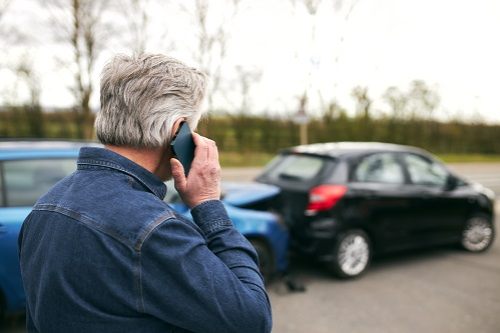
What happens if I have an accident in Canada?
Report any accident in Canada to your insurance company within 24 to 48 hours. Delays beyond that window may complicate your claimAn insurance claim is a request you make to your insurance company for coverage after your car is damaged or you have an accident. You can file a claim online, by phone, or in writing.. In Ontario specifically, you must also visit a Collision Reporting Centre within 24 hours.
Your insurance company will assign a claims adjuster to investigate the accident and walk you through all the paperwork. In case of damage to the vehicle or an injury, the adjuster will conduct interviews with all parties involved and help determine what happened and who was at fault.
Adjusters collect police and accident reports, pictures, and medical records and visit the accident scene whenever possible.
The FSRA - Financial Services Regulatory Authority of Ontario, which regulates the property and property casualty insurance industry and other financial sectors, has some helpful guidelines in case of an accident in their province:
- Stop your vehicle and pull over if it’s safe to do so
- Call police and emergency services if anyone was injured or suspected to be injured
- Exchange your driver’s license and insurance information with the other person involved
- Contact the police if the damage seems to exceed $2,000 or if you’re unsure
- Take pictures of the scene and any damage; this will be helpful in the claims process
- In the province of Ontario, you must visit a Collision Reporting Centre within 24 hours to report the accident
- Don’t leave the scene of the accident, as this can incur criminal charges in certain parts of the country
It’s a good idea to know the procedures for the province you plan to visit.
Will my rates go up if I have an accident in Canada?
Your rates can go up if you are considered at fault – sometimes even partially at fault, even if the accident happened in Canada.
During your claims adjuster’s investigation, the cause of the accident and who is at fault will be determined. This will be a key factor in whether or not your rates will go up.
If the other driver is found at fault, your rates generally will not increase. If fault is shared or assigned to you, a rate increase is possible at your next renewal. Some policies include an accident forgiveness provision that waives the first at-fault surcharge; check your policy's declarations page or contact your insurer to confirm whether this applies to you.
Do I need to buy insurance for a rental car in Canada?
Your personal auto insurance coverage usually extends to a car that was rented in the States and is honored while used in Canada. Be sure to ask the rental company representative if you can drive the vehicle across the border.
Be aware that renting an RV or a vehicle other than a car or SUV may incur additional charges.
The rental car agency can most likely provide you with proof of insurance in case you are pulled over.
In general, a rental car company in Canada will also accept U.S. insurance, so you may not need additional rental car insurance, either. You can purchase additional insurance at the rental agency known as a collision damage waiver (CDW) and other additional insurance. Your credit card may include some coverage for a rental car, so be sure to check. However, the auto insurance you already have provides basic coverage for a rental car.
What should I do if my U.S. insurance doesn't cover me in Canada?
If your U.S. auto insurance does not cover you in Canada, you have several options to obtain coverage before crossing the border.
- Contact your insurer before your trip to confirm whether Canada is included in your policy territory and to add coverage if it is not.
- Purchase a short-term Canadian auto insurance policy through a Canadian insurer or broker if your U.S. policy excludes international coverage.
- Ask your rental car company about coverage options if you are renting rather than driving your own vehicle.
- Check whether your credit card provides rental car coverage in Canada, which may serve as a secondary protection layer.
Other things to know when traveling to Canada
- You need a passport to cross the border and a valid driver’s license to drive a car in Canada.
- If you plan to stay in Canada for an extended period, contact your insurer to confirm how long your U.S. policy remains valid, as coverage duration limits vary by insurer and policy.
- A separate Canadian auto insurance policy may be required for stays beyond your policy's coverage period.
- Entry and visa requirements are separate from insurance requirements; check with Canadian immigration authorities for current rules.
- As with any trip, it might be a good idea to look into travel insurance.
- You can purchase travel insurance at a rental car agency or through a travel agent.
- You cannot legally drive with a U.S. learner's permit in Canada; you must have a valid, full driver's license.
- The age for renting a car in Canada is typically 21, although some companies in Quebec, Saskatchewan and Alberta allow 18-year-olds to rent a car. Confirm rental age requirements before booking.
Being prepared is one of the best ways to have a safe and fun trip. Just make sure you have all of the necessary documents with you when you travel to ensure you’re in compliance with Canadian laws.
FAQ: Car insurance in Canada
Does my State Farm auto insurance cover me in Canada?
Yes, State Farm car insurance generally provides coverage in Canada.
Is there any specific car insurance for visitors in Canada?
No. If you are traveling to Canada from the U.S. and have insurance, you don't need to buy any additional coverage.
Does AAA work in Canada?
Yes. AAA partners with the Canadian Automobile Association (CAA) to provide roadside assistance and other benefits to AAA members in Canada.
Sources:
- Government of Canada. Car insurance - Canada.ca Accessed June 2026
- FSRA. After an Accident: Understanding the Claims Process | Financial Services Regulatory Authority of Ontario (fsrao.ca) Accessed June 2026

 Helpful auto insurance tools and calculators