


Pay-per-mile car insurance: Our recommendation
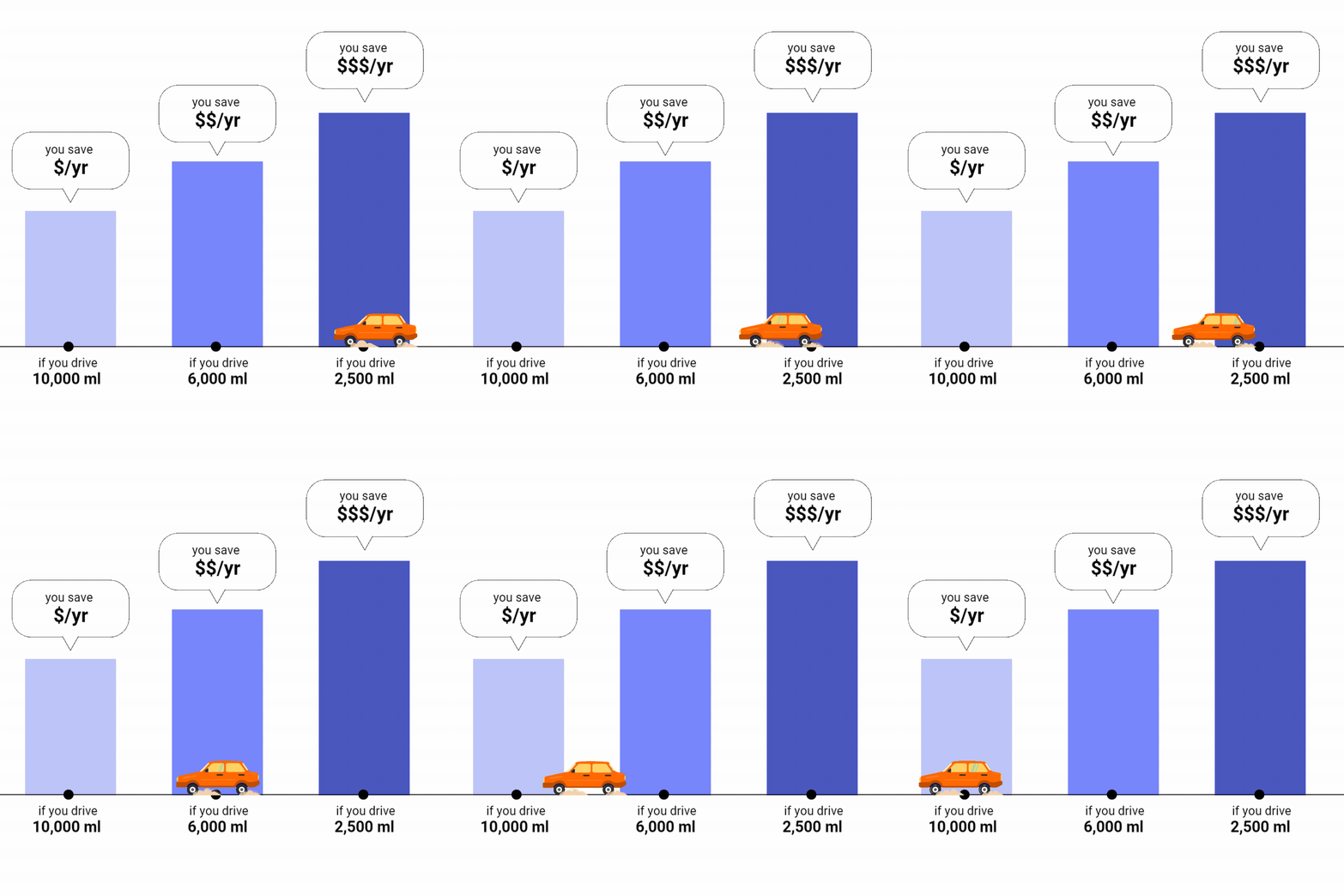
You should consider pay-per-mile car insurance if:
- You drive less than 10,000 miles a year
- You work from home
- You're retired
- You're a stay-at-home parent
You should stick with traditional car insurance if:
- You drive more than 10,000 miles a year
- You need your insurance bill to remain the same each month
What is pay-per-mile car insurance?
Pay-per-mile car insurance is a car insurance policy with rates based on the actual number of miles you drive rather than an estimate. Your rate is a combination of a base rate and a per-mile rate.
Your policy will have the same coverage, including liability coverage, anything else required by law, and comprehensive and collision coverage if you choose to add it.
EXPERT TIP: Many insurance companies offer a low-mileage discount, which works like most other car insurance discounts; you get a reduced rate if you qualify. However, it's still based on an estimated annual mileage, which could be well above what you actually drive.
This type of policy is good for people who work from home, retirees, college students and stay-at-home parents. Pay-per-mile insurance company Mile Auto estimates that 65% of American drivers log fewer than 10,000 miles a year, but insurance companies use 12,000 miles a year as the average. A pay-per-mile plan could save you a lot of money if you're one of those lower-mileage drivers.
Who should consider pay-per-mile car insurance?
Pay-per-mile auto insurance is best for people who don't drive often or drive only short distances.
A good rule of thumb is that you're a good candidate for pay-per-mile car insurance if:
- You're retired. You don’t commute and only drive occasionally to run errands.
- You have a short commute. If you drive a few miles or less to work each day and don’t drive much otherwise, pay-per-mile could work for you.
- You have access to public transportation. Your vehicle is used only occasionally, and you often use public transit to get around.
- You're away at college. Your car is sitting at your parents' home most of the year and is rarely driven. (Most insurance companies offer a student away from home discount, so compare the two options.)
- You work from home. You don’t have a commute and don’t drive much otherwise.
- You have a second vehicle. Pay-per-mile might be a good choice for a second car that is rarely driven.
If you don't drive all that much for any reason and feel like you’re paying too much for insurance you don’t use, you should consider pay-per-mile car insurance.
How does pay-per-mile insurance work?
Pay-per-mile auto insurance works by tracking the actual miles you drive and using that information to calculate your rates in two parts:
- A base rate that uses standard insurance rating factors such as your age, your driving and claims history, the type of vehicle you drive, where you live, and, in most states, your credit history. This base rate is the same every month.
- The rate you'll be charged per mile, which also varies by the driver. This part of the rate will change monthly based on the number of miles you drive that month.
The process of tracking and billing work like this:
- The miles you drive are tracked through a device plugged into the dashboard or an app you use to snap a picture of your odometer.
- The total miles driven is multiplied by your per-mile rate, and that total is added to your monthly base rate.
- You are then sent a monthly bill reflecting the total. That bill will differ each month based on your actual mileage.
ALLSTATE MILEWISE uses a slightly different billing approach. You'll set up an account with a down payment, and the cost of each trip is calculated and deducted from that account within 48 hours. A trip is based on your daily rate plus the cost per mile driven. So, on days you don't drive, there's no charge.
Use our pay-per-mile calculator to estimate how much you can save based on how many miles you drive.
Which companies offer pay-per-mile car insurance?
Pay-per-mile car insurance is offered by Metromile (now part of Lemonade) and MileAuto, both specializing in mileage-based insurance, as well as by major carriers like Allstate and Nationwide.
The companies and the states where the pay-per-mile plan is available are listed below. If your state isn't listed, you still may want to check with the company; these things are constantly changing. It’s worth noting that ByMile, Liberty Mutual’s pay-per-mile program, is no longer listed on the company’s website and is thus not listed here.
Metromile
You can get Metromile insurance in eight states: Arizona, California, Illinois, New Jersey, Oregon, Pennsylvania, Virginia, and Washington.
While it's hard to say what you'll save, one excellent selling point is that Metromile will give you a 250-mile mileage cap (150 miles if you live in New Jersey), so if you decide to make an occasional road trip, where you travel 500 miles in a day, you'll only pay for 250 miles.
Mile Auto
Mile Auto is available in Arizona, California, Georgia, Illinois, Ohio, Oregon, Pennsylvania and Texas.
Mile Auto states that drivers can save 30-40% with its program compared to traditional auto insurance policies.
Nationwide SmartMiles
SmartMiles is now offered in Washington, D.C., and 44 states. It's unavailable in Alaska, Hawaii, Louisiana, North Carolina, New York, or Oklahoma.
How much will you save over regular insurance? It's difficult to say, but Nationwide's website promises an average savings of more than 25%.
Milewise from Allstate
Milewise from Allstate is available in 21 states: Arizona, Delaware, Florida, Idaho, Illinois, Indiana, Maryland, Massachusetts, Minnesota, Missouri, New Jersey, Ohio, Oklahoma, Oregon, Pennsylvania, South Carolina, Texas, Virginia, Washington, West Virginia, and Wisconsin. It’s also offered in Washington, D.C.
Allstate charges its drivers on the Milewise program a daily rate and then the per-mile rate on top of that (a common formula for pay-per-mile auto insurance). The daily rate is reportedly about $2 a day. You can estimate about $60 a month plus the per-mile rate. You might save a lot if your insurance is far above $60 a month and you don't drive much.
How much does pay-per-mile car insurance cost?
Pay-per-mile insurance often costs three to six cents per mile on top of your base rate. For instance, if your base rate is $60 a month, your per-mile rate is 5 cents, and you covered a distance of 400 miles, then you would pay $89 that month.
This is how you can calculate your per-per-mile insurance cost: base rate + (miles covered in a month ×
per mile rate).
For example- $60 (base rate) + (400 × 0.05) = $89
The cost of pay-per-mile insurance varies depending on how much you drive and factors such as your driving history, location, and the make and model of your car. Your bill will change monthly based on actual driving habits that month.
Because pay-per-mile insurance is billed based on how much you drive each month, it can be difficult to estimate how much you'll pay ahead of time. That makes it hard to compare car insurance quotes for pay-per-mile policies.
Is pay-per-mile auto insurance worth it?
Pay-per-mile car insurance programs are worth it for those who drive less than 12,000 miles a year, the average set by many insurance companies.
Mile Auto advertises that its policies may suit qualified drivers who log fewer than 10,000 miles annually. Nationwide SmartMiles says the drivers who typically benefit are those who log fewer than 8,000 miles annually. Nationwide SmartMiles also offers up to a 10% discount for safe driving after the first renewal.
Take note that the occasional long trip won't make your bill skyrocket. That's because most companies stop counting for the day after a certain number of miles — 250 miles at Metromile and Nationwide SmartMiles, for example. (Notable exception: Metromile caps the miles to 150 for New Jersey residents.)
Can you save with pay-per-mile insurance?
Yes, you can save money with a pay-per-mile insurance plan, as long as you drive fewer miles than your current insurer estimates.
You're most likely to save money if you don't drive daily or have a very short commute.
However, be warned that even the per-mile rates can change when your policy renews based on factors tied to the broader insurance market.
Do I need to buy new technology to use pay-per-mile insurance?
No, you will not need to buy any special technology for mileage-based car insurance. The insurance company will provide what you need, either a plug-in device or an app.
Companies that use a dashboard device will provide you with the device, which plugs into your car's onboard diagnostics port (OBD-II). These ports became standard in automobiles in 1996, so unless your car is over 24 years old, it should have an OBD-II port. Some of these devices can be paired with a smartphone, if you choose, to monitor things like your driving behavior or your check engine lights.
If you use Mile Auto, the company has you use your smartphone to take a photo of your odometer each month. However, you won’t be able to use this service if you don't have a smartphone.
Is telematics car insurance the same as pay-per-mile?
No, but they use the same technology. Telematics car insurance, also called usage-based car insurance, tracks driving habits using an in-car tracking device. The in-car tracking devices monitor your driving habits and tendencies, which the company uses to calculate a discount. A mobile app lets you easily access real-time data relevant to your rate. It also alerts if there's something wrong with the vehicle.
Pay-per-mile is only concerned about the distance you drive, while telematics may consider your driving habits to determine what risk you present to the insurance company.
Pay-per-mile car insurance tips
The best tip for saving with pay-per-mile insurance is to make sure you understand how it works and to weigh the pros and cons.
Take a look at the breakdown of the pros and cons below:
Pros
- Pay-per-mile car insurance is cheap. You'll pay less for insurance if you don't drive much.
- Pay-per-mile auto insurance offers more flexibility for drivers than traditional policies do.
- You can save hundreds of dollars a year with pay-per-mile car insurance.
- Low mileage drivers can save even if they have any moving violations or at-fault claims.
Cons
- Pay-per-mile insurance or pay-per-use car insurance isn’t available in all states.
- Pay-per-mile insurance is only for people who drive less than 10,000 miles a year. It's not cost-effective beyond that, and you can get the same coverage with traditional auto insurance policies.
- Only a few companies offer pay-per-mile insurance, so it will be difficult for you to comparison shop.
- Your insurance bill will differ monthly, making it harder to budget and compare quotes.
FAQ: Pay-per-mile insurance
Does pay-per-mile insurance offer additional bonus coverage?
Yes, some companies offer extra coverage. Metromile, for example, automatically includes $1,000 of pet injury protection with its collision and comprehensive policies in all its states except Illinois and Virginia, and roadside assistance can be added.
How is pay-per-mile insurance different from pay-as-you-drive insurance?
The main difference between pay-per-mile and pay-as-you-drive (PAYD) auto insurance is that pay-per-mile plans only consider mileage, while pay-as-you-drive plans tend to be traditional usage-based plans that also consider how you drive.
Is pay-per-mile insurance cheaper than traditional car insurance?
Yes, if you drive significantly fewer miles than average, pay-per-mile insurance is generally cheaper.
Can you lie about mileage on car insurance?
You can, but if you are caught, you could face cancellation for fraud. Insurance companies need accurate information to measure your miles. Most insurers ask you to install a device in your car to monitor your location, driving speed, and how safely you drive, or to regularly take a picture of the odometer.
How do you calculate mileage per year on a car?
You can calculate your car's annual mileage using the odometer. Note the mileage at the start of the year and the finishing mileage, and use this calculation to estimate the next year's mileage.

 Helpful auto insurance tools and calculators
In case you missed it
Stay updated with our latest insurance insights and guides
 September 3, 2026
Multi-car insurance covers two or more cars on one policy. It’s easier...
Read article July 22, 2026Learn how to switch car insurance smoothly by comparing policies, timing cancellations...
Read article July 17, 2026Mechanical breakdown insurance is an optional coverage that can help you pay...
Read article July 15, 2026You can easily transfer your existing insurance coverage to your new car,...
Read article May 5, 2026No-fault car insurance covers your medical bills after an accident, no matter...
Read article October 15, 2025Good reasons to switch car insurance companies include a better rate and...
Read article September 11, 2025Rivian insurance costs an average of $314 per month, but rates may...
Read article September 3, 2025Compare car insurance rates from multiple companies to find the best price...
Read article May 29, 2025Most moving violations will affect your car insurance rates. How much your...
Read article