


Does car insurance cover repairs for your vehicle?
Car insurance covers auto body and other repairs if you carry collision or comprehensive coverage. Collision covers damage from accidents; comprehensive covers damage from non-collision events such as theft, vandalism, hail and flooding. A liability-only policy does not cover repairs to your vehicle.
Comprehensive and collision are part of a full coverage policy, which covers damage to your car, and are required if you have a loan or lease, but not required by law in any state.
Comprehensive and collision will cover damages such as:
You will have to pay a deductibleThe deductible is the amount you pay out of pocket for a covered loss when you file a claim. if you file a claim under your auto body repair insurance. Also, it is important to note that auto body repair insurance typically does not cover the cost of repairing damage to a car's engine or other mechanical breakdowns.
Does car insurance cover bumper damage?
Yes, car insurance will cover bumper damage as long as you have purchased the type of coverage that is relevant to the cause of the damage. Unless another driver is at fault, the coverage will be either collision or comprehensive.
Bumper repair costs vary depending on the severity of the damage and the type of car. Modern bumpers have sensors that help collision avoidance systems. That can also mean costly repairs.
How much does insurance pay for bumper damage?
Your insurance policy should pay for the full cost of damage to the bumper – minus your deductible – as long as you have collision or comprehensive coverageComprehensive coverage helps pay for damage to your car caused by events other than a collision, such as theft, fire, vandalism, or natural disasters. It is subject to a deductible. (depending on the cause of the damage). But it’s important to remember that you must pay that deductible out of pocket before your coverage kicks in.
Ultimately, questions about the cost to repair front-end damage, such as a front bumper, come down to how much damage has been done to the bumper, how expensive the bumper itself is, and how much labor costs.
Auto insurance coverage for a dented bumper
Collision coverageCollision coverage helps pay for repairs or replacement of your car if it's damaged in an accident, regardless of who is at fault and is subject to a deductible. takes care of car bumper repair, subject to your deductible.
You are not required by law to carry collision insurance – although your lender may require you to purchase it -- but you need this type of coverage to fix your vehicle.
Collision insurance has an associated deductible, which is the amount you pay out of pocket before coverage applies.
Should I file an insurance claim for bumper damage?
Filing a claim for bumper damage typically raises your premium at renewal. A first at-fault accident can increase your annual rate from $2,551 to $3,863; a second at-fault accident can push it from $2,551 to $5,492. If your repair cost is close to or below your deductible, paying out of pocket is usually the better financial choice.
Does car insurance cover paint damage?
Yes, car insurance will cover paint damage if you have collision and comprehensive coverage; which one applies depends on the cause of the damage.
Like most of these repairs, the cost to repaint a car can vary depending on the damage. How much does it cost to repair a deep paint scratch? What about multiple scratches? A lot of damage to the paint may require a new paint job.
How much does insurance pay for paint damage?
Insurance will pay as much as is necessary to repair the paint, minus the deductible, up to the actual cash value of your car.
A coat of synthetic enamel paint might cost between $300 to $700 for an average-sized sedan, according to a J.D. Power analysis. On the other hand, if the car requires multiple coats of high-quality paint, the cost can soar into the thousands. So, while you can make a claim for scratches, the cost to repair the damage may or may not make it worthwhile.
If the cost to repair exceeds the value of the car, it may be deemed a total loss.
Auto insurance coverage for paint damage
Auto insurance claims for vandalism are covered by comprehensive insurance, subject to your deductible. If someone scratched your car and didn’t stick around to take responsibility, that’s considered vandalism.
Comprehensive coverage has a deductible that you will need to pay.
If the damage was done by a vandal or a hit-and-run, you will need to file a police report; it’s required by your insurance company that you report the crime.
If another car is involved and the person remains on the scene, coverage will depend on who is at fault. For example, if the scratches happened as another car was backing out next to you and scraped your car, their liability would cover the damage. However, if you were the one backing out, your collision would cover the damage.
Should I file an insurance claim for paint scratches?
If your scratch repair costs $300 to $700 and your deductible is $500 or higher, filing a claim may not be worthwhile. Pay out of pocket when the repair cost is close to your deductible. File a claim when damage requires multiple coats of high-quality paint and the cost exceeds your deductible by thousands.
Rates can go up anytime you file a claim, but in most circumstances, a comprehensive claim shouldn't raise your premium.
Does car insurance cover cracked windshields?
Yes, car insurance covers a cracked windshield. If the damage was caused by a crash or collision, collision will pay; if it was caused by a stone chip, vandalism, weather-related damage, or any other non-collision event, comprehensive applies.
In most cases, if you have comprehensive coverage, fixing a cracked windshield should only cost a small deductible – and possibly nothing at all. However, you could be paying for the new glass if you don’t have a full coverage policy.
How much does insurance pay for a cracked windshield?
Insurance will pay the full cost of fixing or replacing your windshield, minus your deductible, if applicable; some policies waive the deductible for a repair. A small crack can be repaired cheaply, even without insurance. However, windshield replacement can be pricey.
The cost of a replacement windshield varies widely depending on the year and make of the vehicle, says Jon Cardi, senior vice president of strategic client sales and support at glass company Safelite.
"For vehicles that are five years and older with limited features like rain sensors or radio antennas, many common windshields may range from $350 to $450," he says.
Newer, more complex windshields carry advanced safety features such as emergency braking and lane-keeping assist. That means the forward-facing cameras require recalibration when a windshield is replaced.
"The typical cost of the windshield replacement with the recalibration process begins near $800, often surpassing $1,000," Cardi says.
Auto insurance coverage for a cracked windshield
Windshield replacement or repair is covered by comprehensive insurance unless the damage was caused by a collision. The details vary by the insurance company, but most insurers allow you to have your windshield replaced once a year for a small deductible, or, in some cases, no deductible.
There are three states where the law requires windshield replacement to be covered with no out-of-pocket expense for drivers who carry comprehensive insurance coverage, Cardi says.
"South Carolina and Kentucky cover both the windshield and side glass, and Florida covers the windshield only," he says.
In addition, there are five other states where an endorsement of the comprehensive coverage can be purchased to “buy down” the deductible:
- Arizona
- Connecticut
- Massachusetts
- Minnesota
- New York
"There are also a number of carriers that are extending this type of policy to other states, so shopping for the right coverage is important," Cardi says. If you choose to have a crack repaired before it spreads across the windshield, most insurance companies will waive the deductible.
Most insurers offer a full glass rider to your policy, which repairs or replaces glass damage with a zero deductible. This rider tends to be fairly affordable.
Should I file an insurance claim for a cracked windshield?
In many cases, there is no downside to claiming a windshield replacement. You get a new windshield for free or a small deductible and many insurers will not raise your premium at renewal time.
But this is not always the case. Some insurers might raise your premium by a small amount. You should be prepared for this possibility if you file a claim.
Does insurance cover suspension damage?
Insurance will cover suspension damage as long as it was caused by a source that’s covered by comprehensive or collision insurance.
Damage to your suspension can come from a variety of sources, but hitting a pothole is a common cause of damage.
How much does insurance pay for suspension damage?
The cost to repair suspension damage from a pothole can vary dramatically depending on the damage and your vehicle. However, according to the Auto Chimps website, most repairs are likely to cost between $200 to $400 for minor repairs, but major suspension damage can range from $1,000 to $5,000.
Your insurance company should pay for that cost -- minus your deductible -- as long as the damage is related to a covered claim under the terms of your auto insurance policy.
Auto insurance coverage for suspension damage
Your collision coverage pays for suspension damage that was caused by a covered event, such as driving over a pothole.
However, car insurance will not cover regular wear and tear on your suspension.
Collision comes with a deductible. In many cases, the pothole damage may not be enough to make a claim worthwhile.
Should I make an insurance claim for pothole damage?
Probably not, unless the damage is significant and you can't afford to cover the cost out of pocket. Most repairs would fall under your deductible (even if you have a low one, such as $500), so it makes no sense to file a claim.
In addition, filing a collision claim will almost always result in a premium increase. Save your insurance for major repairs and pay for smaller ones out of pocket.
However, if your entire suspension needs to be replaced or you can't afford the repairs, using your insurance may be a necessity.
Does car insurance cover rear-end damage?
Once again, insurance will reimburse you for any covered loss according to the terms of your policy. If you are rear-ended in an accident and you have purchased collision insurance, you should be covered.
How much does insurance pay for rear-end damage?
Rear bumper replacement costs can range from a few hundred dollars for a bumper to $10,000 or more if the frame of your car is bent.
Your insurer should cover any loss that falls within the scope of your policy, minus the deductible.
Auto insurance coverage for rear-end damage
If you are not at fault, the other driver’s insurance will cover your damages, unless the other driver doesn’t have insurance.
The damage to your vehicle would fall under the property damage portion of the other driver’s liability policy. While most industry experts recommend carrying $50,000 in property damage, not everyone follows that advice.
If your fellow motorist only carries the required state minimums, it may not cover all of the damage. Minimums vary by state, but in California, for example, the property damage requirement is a mere $5,000, which will most likely not get your car back on the road.
If the other motorist is entirely uninsured or has low coverage, your collision coverage will pay to repair or replace your vehicle.
If you have it, you may also be able to use the uninsured/underinsured motorist property damage portion of your policy. This coverage kicks in to repair or replace your vehicle if the person who hit you is uninsured or not carrying enough coverage to fix your car.
Should I file an insurance claim for rear-end damage?
In most cases, the other driver's insurance should pay for the damage, as they will usually be found at fault. If they're uninsured or underinsured, you may have to turn to your own policy, assuming you are carrying uninsured/underinsured coverage.
In that case, you will have to decide whether filing a claim makes sense, particularly in light of your deductible. Also, in some states, your rates can rise after filing a claim, even if you are not at fault for the damage.
You will need to carry uninsured/underinsured motorist property damage if you want your car repaired. If you decline the coverage and the person who hit you is uninsured, you may be on the hook for the damages, or headed to court if you end up suing the other driver.
Does car insurance cover mechanical repairs, engine repairs or transmission repairs?
Car insurance does not cover mechanical repairs, engine failures or transmission breakdowns caused by normal wear and tear, lack of maintenance or mechanical failure. Standard collision and comprehensive insurance only pay for repairs when the damage is caused by a covered accident or peril, such as a crash, fire, theft, hail or flooding.
For example, your insurance may cover engine or transmission damage if your car is damaged in an accident or flood. However, it will not pay for repairs if your engine fails due to age, neglect or regular use.
Mechanical repairs that are usually not covered by standard car insurance include:
- Engine failure from wear and tear or poor maintenance
- Transmission breakdowns from normal use
- Brake wear and replacement
- Air conditioning system repairs
- Suspension and steering wear from daily driving
If you want coverage for mechanical breakdowns unrelated to an accident, you may need a vehicle service contract or mechanical breakdown insurance, which some insurers offer separately.
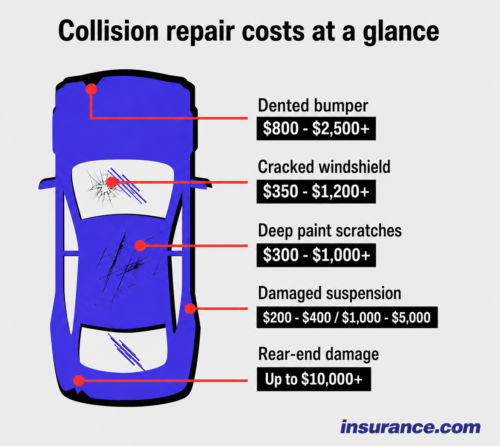
Collision repair costs at a glance
The cost of collision repairs varies depending on what is damaged. Deep paint scratches range from $300 to $1000, while rear-end damage can cost up to $10,000.
- Dented bumper: $800 to $2,500+
- Deep paint scratches: $300 to $1,000+
- Cracked windshield: $350 to $1,200+
- Damaged suspension: $200 to $400 for minor damage; $1,000 to $5,000 for severe damage
- Rear-end damage: Up to $10,000 or more
Sources:
- Eli’s: How much is it to replace or repair a bumper? Accessed May 2026
- J.D. Power: How much does it cost to paint a car? Accessed May 2026
FAQ: Auto body repair
Should I file a car insurance claim for auto body repair?
You should file a car insurance claim for auto body repair if the cost of the damage exceeds your deductible. Filing a car insurance claim will likely raise your premium at renewal. For minor damage that falls near or below your deductible, paying out of pocket costs less over time. If the damage is major and you cannot cover the cost yourself, filing a claim is the practical choice. Some insurers offer accident forgiveness on a first claim, which limits the rate impact.
Should I choose the insurance company's preferred auto body shop?
While your insurer can suggest one of its recommended shops, you are not obliged to use that option.
Auto body shops in the insurance company’s network often guarantee the work, so consider how important that is to you. However, where you have your car repaired is always up to you.
Does full coverage insurance cover car repairs?
Yes, full coverage insurance covers car repairs caused by a collision or a covered non-collision event such as fire, theft or vandalism. It does not cover normal wear and tear or mechanical breakdowns.
Can I claim insurance for car scratches?
Yes, you can file an insurance claim for car scratches if they are caused by a covered peril, such as vandalism or car accidents. However, if the scratch is small and is the only issue with the car, it may not be worth filing a claim.
Do I have to repair my car with an insurance check?
No, you don't have to use the money for repairs. However, if you have a loan, you must repair the damage to your car. Also, you will not be able to file another claim for the same damage if you don’t repair it.
Do auto body shops report damage to insurance?
No, it is up to the policyholder to promptly report damage to the insurance company. The auto body shop has an obligation to fix your car, and nothing more.
Reporting the damage promptly is the best way to start the repair process so you can get back on the road.
Once you have reported the damage, the claims process can begin. The insurance company will perform the initial inspection, discuss the situation with the repair shop, and negotiate a price, says Loretta Worters, vice president of media relations for the Insurance Information Institute.
"Once the job is completed, typically the check is cut to the auto repair shop," she says.

 Helpful auto insurance tools and calculators
In case you missed it
Stay updated with our latest insurance insights and guides
 September 10, 2026
FR-44 insurance is a certificate some states require after serious driving offenses....
Read article May 28, 2026The average full coverage car insurance cost is $2,578 a year nationwide....
Read article May 27, 2026Uninsured and underinsured motorist coverage pays for injuries and damages done by...
Read article May 18, 2026Temporary car insurance is unusual, but options for short-term car insurance coverage...
Read article May 15, 2026You need enough umbrella insurance to cover your assets from liability risks....
Read article April 22, 2026Non-owner auto insurance is liability-only car insurance for drivers who don’t own...
Read article April 17, 2026Comprehensive and collision insurance both cover damage to your car, but from...
Read article February 4, 2026Liability car insurance covers injuries and property damage to others when you’re...
Read article February 4, 2026Gap insurance covers the difference between the actual cash value of your...
Read article August 13, 2025Increasing your liability insurance may cost $50 to $200 more annually, depending...
Read article July 1, 2025PLPD insurance stands for Personal Liability and Property Damage. It covers injuries...
Read article June 19, 2025Broad form car insurance covers one driver with limited liability coverage. It's...
Read article